
The SDG Wedding Cake is a powerful visual and conceptual framework that illustrates how the 17 United Nations Sustainable Development Goals (SDGs) are interconnected and mutually dependent. Developed by the Stockholm Resilience Centre, the model reimagines the SDGs not as separate or competing priorities, but as layers of a single “wedding cake,” where each tier supports the ones above it. This approach emphasizes that sustainable development can only be achieved when social and economic progress is built on a healthy and resilient planet.
At the base of the wedding cake lies the biosphere, which includes SDGs related to the environment: clean water and sanitation (SDG 6), climate action (SDG 13), life below water (SDG 14), and life on land (SDG 15). These goals form the foundation of the model, highlighting a critical message: without stable ecosystems, biodiversity, and a safe climate, human societies cannot thrive. The biosphere provides essential services such as food, water, clean air, and climate regulation, making it the non-negotiable basis for all development.
The middle layer of the cake represents society, encompassing goals that focus on human well-being and social systems. These include no poverty (SDG 1), zero hunger (SDG 2), good health and well-being (SDG 3), quality education (SDG 4), gender equality (SDG 5), reduced inequalities (SDG 10), sustainable cities and communities (SDG 11), peace, justice and strong institutions (SDG 16), and partnerships for the goals (SDG 17). This tier reflects the idea that strong, inclusive, and fair societies depend directly on the health of the biosphere below them.
At the top of the wedding cake sits the economy, represented by goals such as affordable and clean energy (SDG 7), decent work and economic growth (SDG 8), industry, innovation and infrastructure (SDG 9), and responsible consumption and production (SDG 12). In this model, the economy is not an independent driver but a subsystem of society, which itself is a subsystem of the biosphere. Economic activity, therefore, must operate within social and planetary boundaries.
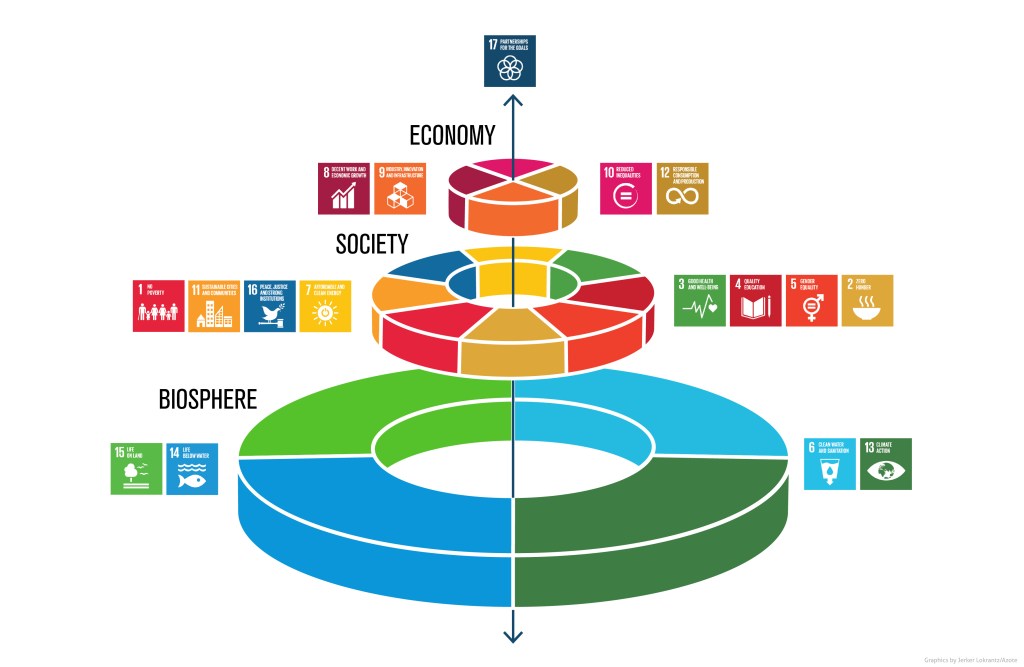
The SDG Wedding Cake challenges traditional development thinking that prioritizes economic growth above all else. Instead, it clearly shows that long-term prosperity depends on social equity and environmental sustainability. For policymakers, businesses, and organizations, this framework encourages integrated decision-making, where environmental protection, social responsibility, and economic performance are addressed together rather than in isolation.In essence, the SDG Wedding Cake offers a clear and intuitive reminder: you cannot enjoy the top of the cake if the bottom collapses. Sustainable development requires a solid environmental foundation, strong social structures, and an economy that serves both people and the planet.
 Green Officer