
Executive Summary
Greece’s performance within the key areas of environmental concern identified in Europe’s environment 2025 reflects a mixed but dynamic picture of progress, persistent challenges, and emerging risks. The country has demonstrated clear advancement in decarbonisation, renewable energy expansion, biodiversity protection, water quality and urban waste treatment. At the same time, implementation gaps, climate vulnerability, resource inefficiencies, unsustainable consumption patterns and socio-economic inequalities present complex obstacles to meeting sustainability goals. This report carefully examines Greece’s performance in the core areas of the EEA’s framework — environment and climate status, socio-economic change, and system transitions (energy, mobility, food) — while integrating specific trends, assessments, strengths, weaknesses and policy implications.
1. Introduction: Positioning Greece in Europe’s Environment 2025
Europe’s environment 2025 offers an integrated assessment of environmental risks and progress across Europe, emphasizing the need for resilience, prosperity and sustainability grounded in environmental health and climate stability. It highlights the triple planetary crises of climate change, biodiversity loss and pollution, and the need for systemic transformation of production and consumption systems. Greece’s country profile, prepared by national experts as part of the EEA’s European Environment Information and Observation Network (Eionet), uses established indicators to present trends specific to the nation across the three analytical dimensions of environment/climate, socio-economic change and system transitions.
Greece’s environmental context is further shaped by its Mediterranean basin location, a biodiversity hotspot with significant ecological endemism, extensive coastline, and acute exposure to climate-driven hazards such as heatwaves, droughts, wildfires and water scarcity. These characteristics interact with socio-economic patterns, infrastructure conditions and governance capacities to produce distinct sustainability outcomes.
2. Environmental and Climate Performance
2.1 Climate Change Mitigation and Emissions Trends
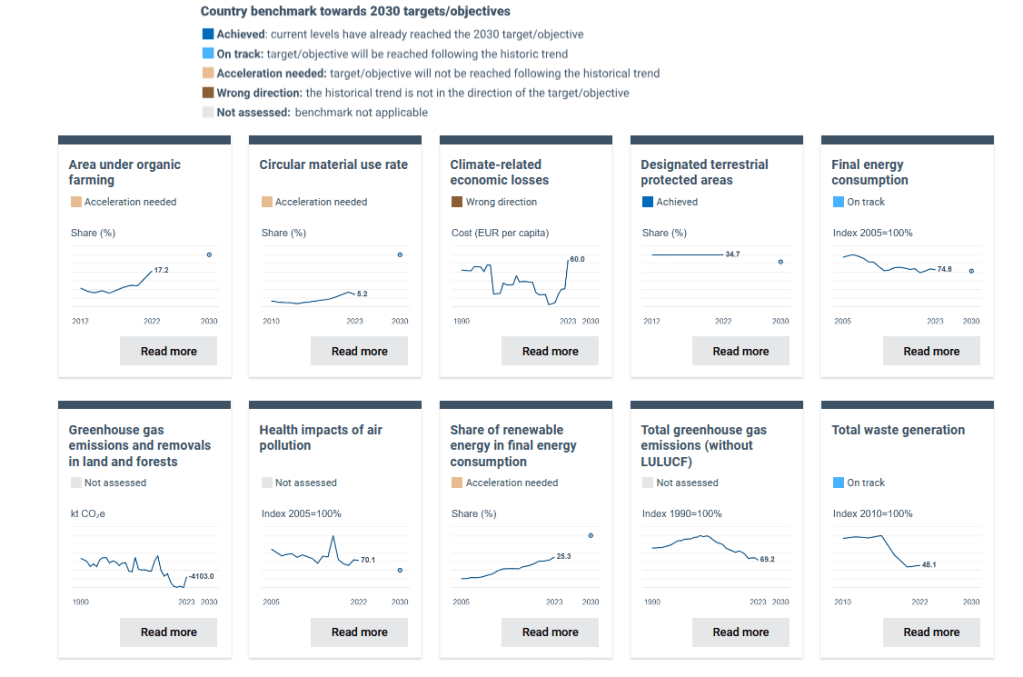
Greece has made notable strides in reducing greenhouse gas (GHG) emissions, contributing to broader European decarbonisation efforts. National data indicate that Greece achieved a significant reduction in net emissions — on the order of nearly 50% from 2005 to 2023 — which is greater than the EU average reduction over the same period.This performance reflects progress within the Emission Trading System (ETS) sectors and consistent achievement in effort-sharing sector targets.
The national climate law aligns Greece with the EU’s overarching goal of climate neutrality by 2050 and specifies a target of a ~55% net emissions reduction by 2030 relative to 1990 levels, underscoring ambition while acknowledging the need for sustained implementation. Progress on emissions from the energy sector shows encouraging trends as coal (lignite) use declines sharply and renewable energy contributions expand, suggesting a strong foundation for future reductions.
However, Greece continues to confront climate-related risks with intensifying frequency and severity of extreme events— particularly heatwaves and wildfires — that exacerbate environmental stress and impose direct socio-economic costs. In 2025, Greece experienced extreme heat and associated wildfires, with implications for labour patterns, public health precautions and ecosystem vulnerability.
These climatic stressors also compound the economic impacts of climate change, as recent analyses indicate that extreme summer weather in 2024 inflicted substantial short-term losses on Mediterranean EU countries including Greece — a signal of the growing fragility of climate-exposed economic sectors like agriculture and tourism.
2.2 Greenhouse Gas Emissions and Carbon Sinks
While Greece has achieved notable emissions reductions, its overall greenhouse gas profile still reflects energy sector dependence on fossil fuels, albeit declining. The energy production sector — historically dominated by lignite — has undergone a rapid transition, with lignite’s contribution to the energy mix falling to low levels in recent years. This ongoing lignite phase-out is an important driver in reducing Greece’s carbon footprint, but residual emissions and the complex socio-economic impacts of deindustrialisation in lignite communities require careful management.
The land use, land-use change and forestry (LULUCF) sector has functioned as a modest carbon sink, contributing to climate targets through afforestation, forest management and other land-based sequestration activities. Drawing on broader European assessments, healthy carbon sinks are critical to offsetting emissions and enhancing climate resilience, but pressures from forest degradation and climate impacts threaten these gains.
2.3 Climate Adaptation and Vulnerability
Adaptation efforts in Greece focus on enhancing resilience to climate impacts such as droughts, wildfires, heat stress, water scarcity and flooding. Europe’s environment 2025 emphasizes that Europe is the fastest-warming continent — and Greece, as a Mediterranean country, is particularly susceptible to heat extremes, drought and fire risk intensification.
National adaptation planning, flood risk management and updated river basin strategies reflect important steps toward strengthening climate resilience. Water management reforms and urban wastewater reuse legislation revisions point to structural adaptation measures designed to secure water availability and quality amid changing climatic regimes.
However, adaptation challenges remain significant. The economic burden of climate events, coupled with uneven infrastructural capacity and resource constraints in water-stressed regions — especially on islands and in the southern mainland — highlight the need for more comprehensive adaptation financing and integrated planning. Investments in early warning systems, nature-based solutions for biodiversity and hydrological management, and climate-smart agriculture are among the priority areas for enhanced resilience.
3. Biodiversity and Ecosystems
3.1 Condition of Natural Habitats and Protected Areas
Greece is one of Europe’s biodiversity hotspots, with a remarkable range of endemic species and diverse ecosystems across mountainous terrain, Mediterranean shrubland, wetlands and extensive coastal waters. This richness places heightened importance on biodiversity protection, but also exposes ecosystems to pressures from human activity and climate stress.
According to the EEA’s country profile, Greece has expanded its terrestrial protected areas to cover approximately 35% of land, exceeding EU targets, and is planning to increase marine protected areas to meet the 30% target aligned with EU biodiversity commitments. Such expansion is a positive step in securing habitats and species, but the integrity of these areas depends on effective management and enforcement.
Despite progress in designating protected areas, overall biodiversity and habitat condition remain under significant pressure from unsustainable land use, agricultural practices, tourism development and infrastructure expansion. The broader European context shows that more than 80% of protected habitats across Europe are in poor condition — a trend that countries like Greece also reflect, given pervasive ecosystem degradation indicators.
3.2 Forests, Wildfires and Land Degradation
Forests in Greece play a dual role as critical biodiversity reservoirs and as carbon sinks. However, they are increasingly vulnerable. Recent reporting has documented unprecedented die-offs in Greek fir forests linked to prolonged drought, reduced snow cover and climate-driven physiological stress, which also predisposes trees to pest outbreaks. These changes underscore the complex interactions between climate change and ecosystem stability.
Wildfires are another recurrent threat to forest ecosystems and rural landscapes. Greece has faced severe wildfire seasons in recent years, with extended heat waves raising the frequency and intensity of fires. Compounding climatic drought with insufficient forest management and fuel load reduction strategies exacerbates biodiversity loss and land degradation. Strengthened fire prevention planning and nature-based resilience investments are critical to sustaining forest health.
3.3 Marine and Freshwater Ecosystems
Greece’s extensive coastline and island ecosystems support rich marine biodiversity, but these systems face pressures from marine litter, pollution, overfishing and habitat fragmentation. Marine protected area expansion aims to counter some of these pressures, yet enforcement, monitoring capacity and cross-sectoral governance are essential to achieving ecological recovery.
On freshwater systems, the ecological condition of surface waters stands at approximately 63.8% good, with most waters in good chemical condition, indicating notable improvements in water quality management and compliance with EU water directives. Drinking water supplies and bathing water quality are described as excellent, reinforcing public health and environmental safety.
Nevertheless, water resources remain under strain from climate change, particularly in southern and island regions prone to worsening drought and declining rainfall. The re-use of treated wastewater and innovative management of river basins are positive developments, but broad implementation and infrastructure upgrades are needed to ensure long-term water security.
4. Pollution, Air Quality and Environmental Health
4.1 Air Pollution Trends
Air quality in Greece has shown signs of improvement in recent years, in line with European trends of reduced emissions of major air pollutants. Compliance with the National Emission Reduction Commitments Directive for 2020–2029 reflects progress in lowering concentrations of pollutants such as nitrogen oxides and particulate matter. Nonetheless, additional reductions — particularly in PM2.5 — are required to meet 2030 targets.
Across Europe, air pollution remains a significant health burden, with fine particulate matter exposure contributing to premature deaths. While national trends in Greece mirror broader EU improvements, urban areas and regions with concentrated transport emissions still exhibit air quality challenges that require integrated policy responses including transport electrification and emission controls.
4.2 Waste Management and Circularity
Greece’s circularity performance — an indicator of how efficiently resources are recovered and reused — experienced a decline in recent years due to increased domestic material consumption and limited substitution of raw materials. This reflects structural challenges in waste reduction and recovery systems.
In response, Greece has revised its national waste management framework and adopted a circular economy action plan (2021–2025) alongside a national programme to promote waste prevention (2021–2030). These strategic instruments are geared toward improving material efficiency, reducing landfill usage and promoting recycling and reuse. The ongoing LIFE-IP CEI-Greece project (2019–2027) is a key initiative supporting national circular economy and waste prevention efforts.
Persistent waste management deficits and low recycling rates relative to EU averages underscore the need for stronger enforcement, infrastructure investment and public engagement to shift consumption patterns and achieve sustainable material use.
4.3 Water Quality and Sanitation
Water quality performance in Greece is a relative strength. Surface waters show a majority portion in good ecological and chemical condition, drinking water quality is high, and urban wastewater treatment systems continue to improve. These outcomes reflect successful implementation of EU water policy frameworks and monitoring systems.
However, water scarcity risks driven by prolonged droughts and climate change remain pressing. Strategic investments in reservoirs, river transfers and desalination — including a proposed national water management plan — are emerging priorities to secure water supply for growing urban populations amid climatic uncertainty.
5. Socio-Economic Change and Sustainable Development
5.1 Sustainable Development Goals (SDGs) and Socio-Economic Indicators
Greece’s overall performance across sustainable development indices reveals a mixed pattern. While progress is evident in areas such as clean water and sanitation, sustainable energy, climate action and life below water (marine health), the country lags behind EU averages on SDG 12 (Responsible Consumption and Production) due to material consumption and resource inefficiencies.
Moreover, regions within Greece still face significant challenges regarding SDG 1 (No Poverty) and SDG 10 (Reduced Inequalities). Income inequality, measured by the Gini coefficient, declined for a period but has shown an uptick in recent years. Energy poverty also remains above the EU average despite overall downward trends, highlighting socio-economic vulnerabilities that intersect with environmental conditions.
Educational and digital divides between urban and rural areas further complicate socio-economic cohesion and access to green opportunities, reinforcing the need for inclusive policies that align environmental progress with social well-being.
5.2 Green Economy, Eco-Innovation and Employment
Despite persistent socio-economic challenges, Greece has exhibited positive trends in eco-innovation and employment in the environmental goods and services sector. The Eco-Innovation Index demonstrates upward movement, with the highest increase in the EU between 2013 and 2022 — a reflection of rising environmental innovation capacity and integration of green priorities into the national recovery and resilience plan.
This eco-innovation transition translates into employment gains and contributions to gross value added, suggesting that sustainable economic sectors have growth potential and can play a role in broader economic resilience. Continued investment in green skills, research and innovation ecosystems and business support will reinforce these trends.
5.3 Governance, Policy Implementation and Public Engagement
While Greece has adopted a suite of environmental laws and strategies, effective enforcement remains a challenge, particularly in areas such as waste management, urban wastewater treatment infrastructure, land planning and environmental impact assessment. Historical infringement cases and fines indicate ongoing implementation gaps.
Public awareness and behavioural shifts are increasing, as many citizens report adopting pro-environmental practices. However, surveys reveal lower willingness to pay for climate and environmental actions and limited recognition of broader societal benefits, pointing to the need for enhanced environmental education, participatory policy-making and transparent communication about long-term benefits of sustainability transitions.
6. System Transitions: Energy, Mobility and Food
6.1 Energy Transition
Greece’s energy system is undergoing a significant transformation from fossil fuel dependence toward renewable energy sources. The decline of lignite in the energy mix — once the backbone of domestic electricity production — represents one of the pillars of emissions reduction progress. Renewable energy expansion, particularly in solar and wind, supports national and EU decarbonisation trajectories.
Despite this transition, energy affordability and distributional impacts remain key concerns. Energy poverty — households unable to adequately heat or cool their homes — persists well above EU averages, highlighting gaps between systemic decarbonisation and social equity. Addressing this requires integrated policies that combine clean energy deployment with social protection, energy efficiency upgrades and targeted financial support.
6.2 Mobility and Transport
Greece’s mobility system is evolving in response to EU climate and sustainability frameworks. Policy incentives and behavioural shifts have gradually increased the adoption of electric vehicles (EVs), biking and micromobility, particularly in major urban centres like Athens and Thessaloniki. Subsidy programmes, tax incentives and charging infrastructure grants support the transition to low-emission transport.
Public transport improvements — including metro and tram expansions and initiatives to electrify bus fleets — signal progress, although the ageing vehicle fleet and limited alternative fuels infrastructure create persistent barriers to rapid decarbonisation of the transport sector. Comprehensive mobility planning and investments in multimodal sustainable systems remain priorities for emissions reductions and urban air quality improvement.
6.3 Food Systems and Sustainable Consumption
Food systems in Greece, as in much of Europe, sit at the intersection of environmental pressures and consumption patterns. Reforms in food labelling and gradual uptake of plant-based diets reflect shifting consumer awareness toward healthier and more sustainable choices, but reliance on processed foods and cost-driven purchasing behaviour challenge progress.
Agriculture contributes to environmental pressures including greenhouse gas emissions, land use change and water demand, underscoring the need for climate-smart agriculture, sustainable land management and nutrition-sensitive policy frameworks that align production systems with ecological and health outcomes.
7. Key Challenges and Strategic Priorities
Despite important achievements, Greece’s environmental performance within the Europe’s environment 2025 framework confirms that multiple strategic challenges remain:
7.1 Implementation Gaps and Governance
- Enforcement of environmental legislation and compliance with EU directives need strengthening.
- Investments in environmental infrastructure (waste, water, biodiversity monitoring) must accelerate.
- Integrated cross-sectoral policy frameworks are required to bridge policy goals and outcomes.
7.2 Climate Adaptation and Resilience
- Expanding climate adaptation planning and financing is essential, particularly for drought-prone regions, wildfire prevention and water security.
- Nature-based solutions, ecosystem restoration and resilient urban planning should be mainstreamed across sectors.
7.3 Resource Efficiency and Circularity
- Improving circularity rates through effective waste management, recycling infrastructure and resource substitution remains a priority.
- Public and private sector initiatives must align to reduce material consumption and streamline resource flows.
7.4 Socio-Economic Equity and Inclusion
- Addressing energy poverty and regional inequalities is essential to ensure that the environmental transition is socially just.
- Education, public engagement and incentives for sustainable lifestyles will reinforce long-term behavioural change.
7.5 Sustainable Food Systems
- Supporting climate-resilient agriculture and sustainable food consumption can reduce environmental pressures and enhance public health outcomes.
8. Conclusions
Greece’s performance within the key areas of concern highlighted in Europe’s environment 2025 reveals a country at a critical juncture. Strong progress in emissions reductions, renewable energy deployment, biodiversity area protection and water quality improvements demonstrates Greece’s ability to align national efforts with European sustainability goals. Nevertheless, persistent challenges — including governance implementation gaps, socio-economic inequalities, climate vulnerabilities, resource inefficiencies and consumption patterns — require strategic action and sustained investment.
The integration of environmental goals with socio-economic policies, strengthened institutional capacities, and robust stakeholder engagement will be essential in consolidating progress and enhancing resilience. Greece’s journey toward environmental sustainability mirrors broader European imperatives: bold ambition must be matched with effective policies, long-term planning and inclusive approaches to ensure a resilient and prosperous future.
 Green Officer