
Why Sovereignty Is Settled—but Strategic Competition Is Not
Policy Brief | Arctic Security & Geopolitics
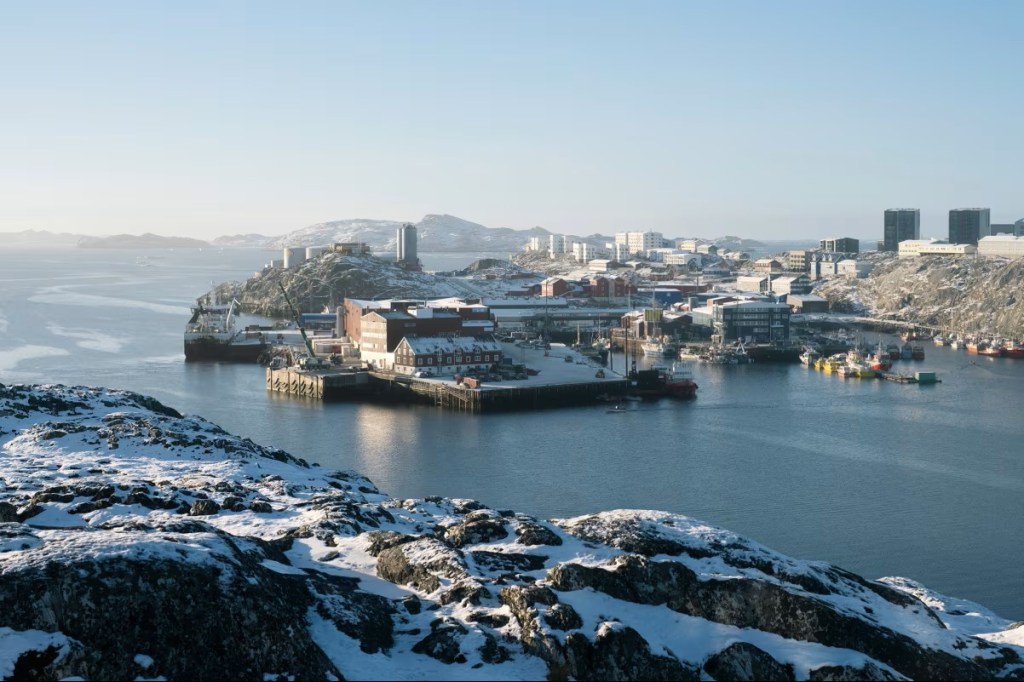
Juliette Pavy/Bloomberg/Getty Images
Introduction
Greenland has re-emerged as a focal point of Arctic geopolitics due to climate change, renewed great-power rivalry, and growing competition over access, infrastructure, and military positioning in the High North. Although Greenland’s sovereignty under the Kingdom of Denmark is firmly established in international law, the island’s strategic location between North America and Eurasia has drawn increasing attention from the United States and, indirectly, Russia.
This policy brief argues that Greenland is unlikely to become the subject of a formal sovereignty dispute, particularly involving the United States. Instead, competition will center on de facto influence: defense access, infrastructure investment, resource development, and political alignment with Greenland’s self-governing institutions. Russia’s interest is strategic rather than territorial, driven by Arctic militarization and NATO dynamics rather than legal claims.
The future of Greenland will not be decided by annexation or legal contestation, but by how effectively Denmark, Greenlandic authorities, and allied partners manage security cooperation, economic development, and self-determination amid accelerating Arctic change.
Key Judgments
- Sovereignty over Greenland is legally settled under Danish authority and reinforced by Greenlandic self-determination.
- The United States will not pursue a formal sovereignty debate, but will expand its strategic footprint through defense, diplomacy, and investment.
- Russia does not seek territorial claims over Greenland, but views it as a critical node in NATO’s Arctic posture.
- Climate change is transforming Greenland from a peripheral territory into a strategic platform, reopening political—not legal—questions.
- The primary risk is not territorial conflict but governance imbalance, where security imperatives outpace local political and economic capacity.
Why Greenland Matters Strategically
Greenland occupies one of the most strategically consequential locations in the Arctic:
- It sits astride the Greenland–Iceland–UK gap, a key corridor for transatlantic military and naval movement.
- It anchors early-warning and missile-defense systems critical to North American security.
- It is increasingly relevant for Arctic shipping routes and undersea infrastructure.
- It hosts potential deposits of rare earth elements, uranium, and other strategic minerals essential for energy transition technologies.
As Arctic ice recedes, Greenland’s relevance shifts from theoretical to operational (Dodds & Nuttall, 2019).
Historical Context: Why Greenland Was Ever Contested
Greenland’s debated status is rooted in imperial succession rather than unresolved sovereignty.
- Norse settlement in the medieval period tied Greenland to the Norwegian Crown.
- Danish sovereignty was consolidated through legal succession and affirmed by continuous administration.
- The 1933 Permanent Court of International Justice ruling decisively rejected Norwegian claims, establishing Denmark’s legal authority (PCIJ, 1933).
Unlike many colonial territories, Greenland’s status was settled early in international jurisprudence. Subsequent disputes have been strategic rather than legal.
The United States: Influence Without Ownership
A Longstanding Strategic Interest
U.S. interest in Greenland is neither new nor accidental. The United States:
- Considered acquiring Greenland in 1867 and again in 1946.
- Assumed de facto responsibility for Greenland’s defense during World War II.
- Built and continues to operate critical military infrastructure at Thule (Pituffik) Space Base during the Cold War and beyond.
These actions demonstrate a consistent U.S. assessment: Greenland is indispensable to North American security (Doel et al., 2014).
Why the U.S. Will Not Challenge Sovereignty
Despite periodic rhetoric, several factors constrain U.S. action:
- International law strongly favors Denmark and Greenlandic self-rule.
- Political precedent would undermine U.S. positions on territorial integrity elsewhere.
- Operational access already exists, reducing the incentive for ownership.
The 2019 proposal to “purchase” Greenland was best understood as a signal of strategic urgency, not a viable policy pathway (Depledge, 2020).
Likely U.S. Approach Going Forward
- Expanded defense cooperation
- Direct diplomatic engagement with Greenland’s government
- Economic investment in infrastructure and minerals
- Support for Greenland’s gradual capacity-building without endorsing premature independence
Denmark: Sovereignty With Constraints
Denmark retains formal sovereignty but operates under growing constraints:
- Greenland’s Self-Government Act (2009) recognizes the right to independence.
- Copenhagen must balance NATO commitments with Greenlandic political legitimacy.
- Economic dependence on Danish block grants limits Greenland’s strategic autonomy.
Denmark’s challenge is not defending sovereignty, but maintaining relevance as Greenland’s primary partner amid rising external interest (Ackrén, 2014).
Russia: Strategic Rival, Not Legal Challenger
Russia has no legal claim to Greenland and has shown no intention of asserting one. However, Greenland features prominently in Russia’s strategic calculus:
- U.S. and NATO infrastructure in Greenland affects Russia’s Arctic deterrence posture.
- Greenland contributes to missile-defense and early-warning architectures Moscow views as destabilizing.
- Arctic militarization heightens Greenland’s role in escalation scenarios (Conley et al., 2020).
From Russia’s perspective, Greenland is a strategic platform, not a territorial objective.
Climate Change: The Strategic Accelerator
Climate change intensifies all existing dynamics:
- Melting ice increases access to resources and transit routes.
- Environmental vulnerability raises governance and security costs.
- External actors gain incentives to shape development trajectories.
These pressures risk outpacing Greenland’s administrative and political capacity, creating openings for asymmetric influence rather than overt control (Lajeunesse & Lackenbauer, 2019).
Policy Implications
For the United States
- Treat Greenland as a partner, not a possession
- Align security investments with local political consent
- Avoid rhetoric that undermines self-determination norms
For Denmark
- Modernize the Kingdom framework to reflect Arctic realities
- Increase transparency around defense agreements
- Support Greenlandic economic diversification
For Greenlandic Authorities
- Leverage strategic interest without over-securitization
- Diversify partnerships while avoiding dependency
- Invest in governance capacity ahead of independence debates
For NATO and Allies
- Integrate Greenland into Arctic strategy as a political actor
- Avoid framing the Arctic exclusively through military competition
- Reinforce rules-based governance in the High North
Conclusion
Greenland’s sovereignty is not up for renegotiation—but its strategic alignment is increasingly contested. The island exemplifies a broader shift in international politics, where influence is exercised through access, infrastructure, and partnership rather than annexation.
The United States will not debate Greenland’s sovereignty extensively in legal terms. Instead, it will seek to ensure that Greenland remains firmly embedded within the Western security and political order. The decisive question is not who owns Greenland, but who shapes its future.
 Green Officer