
Abstract
Greenland, the world’s largest island, occupies a paradoxical position in international relations: geographically peripheral yet geopolitically central. Historically contested through Norse colonization, Danish–Norwegian sovereignty, colonial administration, and Cold War militarization, Greenland has re-emerged in the twenty-first century as a focal point of renewed great power competition. Climate change, Arctic militarization, rare-earth resource potential, and evolving international law have intensified strategic interest from Denmark, the United States, and Russia. This article examines the historical foundations of Greenland’s contested status, the legal and political basis of Danish sovereignty, the strategic motivations of U.S. engagement, and Russia’s indirect but consequential interest. It further assesses whether the United States is likely to formally challenge Greenland’s sovereignty or continue pursuing influence through security, economic, and geopolitical mechanisms. The analysis demonstrates that while formal sovereignty claims are improbable, Greenland represents a critical test case for the evolving nature of territorial control, self-determination, and Arctic governance in a warming world.
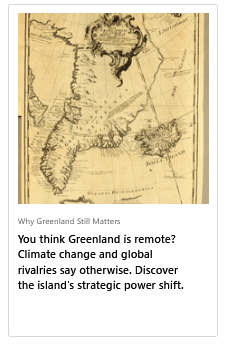
1. Introduction: Why Greenland Matters Now
For much of modern history, Greenland appeared to be a geopolitical backwater—icebound, sparsely populated, and distant from the centers of global power. Yet this perception has always been misleading. Greenland’s strategic value lies not in its population but in its location, resources, and legal status. Situated between North America and Eurasia, Greenland forms a natural bridge across the Arctic, controlling access routes between the Atlantic and Arctic Oceans. As polar ice retreats, these routes are no longer theoretical but increasingly navigable (Dodds & Nuttall, 2019).
Recent global developments—accelerating climate change, renewed NATO–Russia confrontation, and intensified U.S.–China rivalry—have transformed Greenland into a strategic linchpin. Public attention peaked when the United States openly expressed interest in acquiring Greenland in 2019, reviving long-standing debates about sovereignty, autonomy, and imperial legacies (Depledge, 2020). Although the proposal was widely dismissed as unrealistic, it underscored enduring tensions embedded in Greenland’s political status.
This article argues that Greenland’s contested nature is not an anomaly but the product of layered historical, legal, and geopolitical processes. Understanding why Denmark, the United States, and Russia are invested—albeit in different ways—requires tracing Greenland’s evolution from medieval settlement to modern strategic asset.
2. Early Claims and Norse Foundations
Greenland entered recorded European history through Norse exploration. Around 985 CE, Erik the Red established settlements along Greenland’s southwestern coast. These settlements were politically tied to Iceland and later incorporated into the Norwegian Crown. Crucially, Norse claims were framed not as terra nullius but as extensions of existing European polities (Gad, 2009).
The Norse presence declined by the fifteenth century, likely due to climatic cooling (the Little Ice Age), economic isolation, and conflict with Inuit populations. However, from a legal-historical perspective, the disappearance of settlements did not automatically extinguish sovereignty claims under medieval European norms. This continuity later became central to Danish arguments for legal succession.
Parallel to Norse colonization, Inuit peoples—ancestors of today’s Kalaallit—maintained continuous habitation across Greenland. Their presence complicates European claims but was historically marginalized within colonial legal frameworks, which prioritized discovery and crown succession over indigenous sovereignty (Tester & Kulchyski, 1994).
3. Danish–Norwegian Sovereignty and Colonial Administration
Following the Kalmar Union and subsequent political realignments, Greenland became administratively linked to Denmark-Norway. When the dual monarchy dissolved in 1814, the Treaty of Kiel transferred Norway to Sweden but explicitly retained Greenland, Iceland, and the Faroe Islands under Danish control. This treaty remains the cornerstone of Denmark’s international legal claim (Churchill & Ulfstein, 2010).
Throughout the nineteenth and early twentieth centuries, Denmark exercised effective control over Greenland through trade monopolies, missionary activity, and colonial administration. This “effective occupation” later proved decisive in international law. In the 1933 Permanent Court of International Justice (PCIJ) ruling on the Eastern Greenland case, Denmark successfully defended its sovereignty against Norwegian claims by demonstrating continuous and peaceful authority (PCIJ, 1933).
This ruling is critical: it established Greenland as a legally settled territory under international law, sharply limiting the plausibility of external sovereignty challenges. However, legal sovereignty did not equate to political autonomy for Greenland’s indigenous population, whose governance remained firmly under Danish control.
4. World War II and the Transformation of Strategic Value
Greenland’s geopolitical significance shifted dramatically during World War II. After Nazi Germany occupied Denmark in 1940, Greenland became effectively detached from Copenhagen. The United States, invoking hemispheric defense principles, assumed responsibility for Greenland’s security, establishing airfields and weather stations crucial to the Allied war effort (Young, 2016).
This period marked the first sustained U.S. military presence on the island and set a precedent for American involvement independent of Danish authority. Although sovereignty remained formally Danish, the war demonstrated that control and sovereignty could diverge in practice.
Following the war, the United States offered to purchase Greenland outright in 1946—a proposal Denmark rejected. The episode is often portrayed as an eccentric historical footnote, but it reveals a long-standing American perception of Greenland as strategically indispensable (Doel et al., 2014).
5. The Cold War: De Facto American Control Without Sovereignty
During the Cold War, Greenland became a cornerstone of U.S. Arctic defense strategy. The establishment of Thule Air Base (now Pituffik Space Base) in northwest Greenland enabled early warning systems against Soviet missile attacks. Under bilateral defense agreements, Denmark permitted extensive U.S. military infrastructure while retaining formal sovereignty.
This arrangement illustrates a recurring theme in Greenland’s history: functional control without formal annexation. For the United States, sovereignty was less important than assured access and operational freedom. For Denmark, U.S. presence reinforced NATO security while preserving legal ownership.
Notably, Greenlandic voices were largely excluded from these arrangements. The forced relocation of Inuit communities near Thule in the 1950s exemplifies the human costs of strategic militarization (Nuttall, 2012). These experiences later fueled Greenlandic demands for autonomy and self-determination.
6. Home Rule, Self-Government, and the Question of Independence
Greenland’s political status evolved significantly in the late twentieth century. In 1979, Denmark granted Home Rule, followed by expanded Self-Government in 2009. Under the Self-Government Act, Greenlanders were formally recognized as a people with the right to self-determination under international law (Ackrén, 2014).
This legal framework complicates external sovereignty debates. Any attempt by the United States—or any other power—to claim Greenland would directly contradict the principle of self-determination, now embedded in both Danish law and international norms.
Yet autonomy does not equal independence. Greenland remains economically dependent on Denmark, particularly through annual block grants. This dependency creates a strategic vulnerability: external actors can seek influence not by challenging sovereignty, but by shaping economic and security choices.
7. Russia and Greenland: Indirect Rivalry in the Arctic
Unlike Denmark and the United States, Russia does not claim Greenland nor possess a historical legal basis to do so. However, Greenland figures prominently in Russia’s Arctic strategy due to its location within the broader Arctic security architecture.
Russia views the Arctic as a core national interest, investing heavily in military modernization, icebreaker fleets, and infrastructure along the Northern Sea Route (Conley et al., 2020). Greenland’s proximity to key Arctic chokepoints makes it strategically relevant in any NATO–Russia confrontation.
From Moscow’s perspective, U.S. military expansion in Greenland represents an extension of American encirclement. Thus, Russia’s “claim” over Greenland is not territorial but strategic: it seeks to limit Western dominance and preserve freedom of maneuver in the Arctic. Greenland becomes a geopolitical variable, not an object of annexation.
8. The United States: Will Sovereignty Be Debated Extensively?
The critical question is whether the United States is likely to seriously debate Greenland’s sovereignty in the future. Historical precedent suggests caution. Despite repeated interest—1867, 1946, and 2019—the U.S. has never pursued formal annexation beyond exploratory discussions.
Several factors make an extensive sovereignty debate unlikely:
- International Law: Greenland’s status is legally settled under Danish sovereignty and reinforced by Greenlandic self-determination.
- Political Cost: Challenging sovereignty would undermine U.S. credibility on territorial integrity, particularly in light of opposition to Russian actions in Ukraine.
- Strategic Sufficiency: The U.S. already enjoys extensive access through defense agreements, making sovereignty unnecessary.
However, this does not mean U.S. engagement will diminish. On the contrary, the United States is likely to intensify de facto influence through:
- Expanded military presence
- Investment in infrastructure and rare-earth projects
- Diplomatic engagement with Greenlandic authorities
In this sense, sovereignty becomes less relevant than alignment.
9. Climate Change and the Reopening of Frozen Politics
Climate change acts as a force multiplier in Greenland’s geopolitical relevance. Melting ice exposes mineral resources, including rare earth elements critical for green technologies. It also enhances Arctic navigability, increasing the island’s strategic value (Lajeunesse & Lackenbauer, 2019).
These developments reopen questions once considered settled—not legally, but politically. Who controls access? Who benefits economically? Who provides security? Greenland’s future will be shaped not by formal sovereignty disputes, but by how these questions are answered.
10. Conclusion: Greenland and the Future of Arctic Sovereignty
Greenland’s contested status is best understood not as an unresolved legal dispute, but as a persistent strategic tension between sovereignty, control, and self-determination. Denmark’s legal claim is strong, Russia’s interest is indirect, and the United States’ ambitions are pragmatic rather than imperial.
The United States is unlikely to debate Greenland’s sovereignty extensively in formal terms. Instead, it will pursue influence through security partnerships and economic engagement, consistent with historical practice. Greenland thus exemplifies a broader transformation in international relations: where power is exercised less through annexation and more through networks, access, and alignment.
In a warming Arctic, Greenland stands not as a relic of imperial rivalry, but as a preview of how territory, law, and power will interact in the twenty-first century.
References (Selected)
Ackrén, M. (2014). Greenlandic identity and self-government. Arctic Review on Law and Politics.
Churchill, R., & Ulfstein, G. (2010). The dispute concerning sovereignty over the island of Hans. Ocean Development & International Law.
Conley, H. A., et al. (2020). America’s Arctic moment. CSIS.
Depledge, D. (2020). Britain and the Arctic. Cambridge University Press.
Dodds, K., & Nuttall, M. (2019). The Arctic: What everyone needs to know. Oxford University Press.
Doel, R. E., et al. (2014). Strategic Arctic science. Palgrave Macmillan.
Gad, U. P. (2009). Post-colonial identity in Greenland. Routledge.
Nuttall, M. (2012). Imagining Greenland. University of Chicago Press.
Permanent Court of International Justice (1933). Legal status of Eastern Greenland.
Tester, F., & Kulchyski, P. (1994). Tammarniit (mistakes). UBC Press.
Young, O. R. (2016). Governing the Arctic. Oxford University Press.
 Green Officer