
Environmental, Social, and Governance (ESG) materiality is a critical driver of long-term corporate financial performance and risk management, making it an indispensable pillar of modern investment strategy.
The Materiality of ESG Factors: Driving Value, Investment Strategy, and the EU Taxonomy Framework
Introduction: The Evolution of Value Creation
The paradigm of modern finance has shifted dramatically. For decades, the dominant corporate objective—championed by Milton Friedman—was shareholder primacy, dictating that a company’s sole social responsibility was to increase its profits within the rules of the game. Today, this narrow view has been superseded by stakeholder capitalism. Investors, regulators, consumers, and employees increasingly recognize that long-term enterprise value cannot be decoupled from ecological stability, social cohesion, and ethical governance.
Environmental, Social, and Governance (ESG) criteria are no longer auxiliary or “feel-good” filters used exclusively by values-driven funds. They represent fundamental financial metrics that expose operational vulnerabilities, regulatory exposure, and future growth potential. Central to this integration is the concept of materiality—the principle determining which ESG factors are financially significant to a specific business sector or enterprise.
This article provides an exhaustive analysis of ESG materiality, examines how individual ESG factors drive investment performance, outlines why ESG must anchor a resilient modern investment strategy, and delivers a rigorous breakdown of the European Union (EU) Taxonomy Regulation.
1. The Concept of Materiality: Single vs. Double Materiality
To evaluate ESG factors effectively, an investor must first understand materiality. In traditional accounting, an item is material if its omission or misstatement could influence the economic decisions of users taken on the basis of the financial statements. When applied to ESG, materiality splits into two core philosophies: single materiality and double materiality.
Single Materiality (Financial Materiality)
Single materiality focuses exclusively on how external ESG factors impact a company’s financial condition, operating performance, and cash flows (an “outside-in” perspective).
- Focus: Enterprise value creation and risk mitigation.
- Example: How rising carbon taxes or extreme weather events driven by climate change threaten a manufacturing firm’s supply chain and profit margins.
- Adherents: Traditionally favored by standard-setting bodies like the Sustainability Accounting Standards Board (SASB), which looks at financially material sustainability risks for specific industries.
Double Materiality
Double materiality expands the lens. It argues that materiality has two dimensions that are increasingly intertwined:
- The Outside-In Perspective: How sustainability factors affect the company’s financial performance (Financial Materiality).
- The Inside-Out Perspective: How the company’s operations, products, and footprints impact the external environment and society (Impact Materiality).
- Focus: A holistic view recognizing that negative social or environmental impacts will eventually internalize as financial risks (e.g., through reputational damage, consumer boycotts, litigation, or regulatory fines).
- Adherents: Championed by the European Union under the Corporate Sustainability Reporting Directive (CSRD) and the Sustainable Finance Disclosure Regulation (SFDR).
2. Dissecting ESG Factors When Investing
Integrating ESG requires breaking down the acronym into its constituent pillars and understanding the specific mechanisms through which each factor generates or destroys economic value.
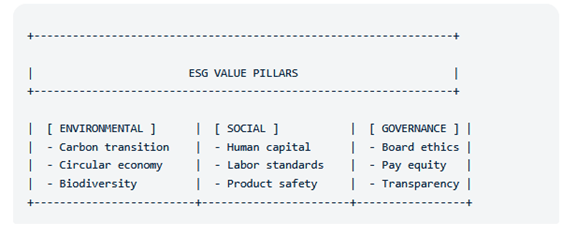
The Environmental (E) Pillar
The Environmental pillar addresses a company’s stewardship of the natural world. Far from being limited to carbon emissions, it encompasses a wide array of sub-factors:
- Climate Change & Carbon Transition: Mitigation and adaptation strategies relating to greenhouse gas (GHG) emissions, energy efficiency, and transition risk toward a low-carbon economy.
- Natural Capital & Biodiversity: Land use, deforestation impacts, water stress management, and the preservation of ecosystems upon which supply chains rely.
- Circular Economy & Waste: Management of toxic waste, packaging lifecycles, recycling infrastructure, and resource scarcity adaptation.
Value Impact: Environmental factors act as massive catalysts for asset impairment (stranded assets in fossil fuels), cost inflation (carbon pricing mechanisms), and operational disruption (water shortages halting semiconductor fabrication). Conversely, proactive environmental management unlocks green market subsidies, lower energy overheads, and premium product positioning.
The Social (S) Pillar
The Social pillar evaluates how a company manages relationships with its workforce, suppliers, customers, and communities.
- Human Capital Management: Employee engagement, talent retention, health and safety standards, fair wages, and training opportunities.
- Diversity, Equity, and Inclusion (DEI): Representation across all organizational tiers, fostering cognitive diversity and reducing groupthink.
- Human Rights & Supply Chain Ethics: Auditing tier-1 through tier-n suppliers for forced labor, child labor, and safe working conditions.
- Consumer Welfare: Product safety, data privacy, and ethical marketing.
Value Impact: Human capital is the primary engine of modern service and tech economies; high turnover and low morale destroy productivity and inflate recruitment costs. Social controversies (e.g., severe workplace safety violations or supply chain exploitation) can erase billions in market capitalization overnight via consumer boycotts and regulatory intervention.
The Governance (G) Pillar
Governance is the bedrock of corporate integrity. It dictates how a corporation is directed, administered, and controlled.
- Board Independence & Diversity: Ensuring non-executive directors possess genuine independence from management and diverse professional backgrounds to provide robust oversight.
- Executive Compensation Alignment: Tying management pay packages to long-term performance metrics, including explicit ESG targets, rather than short-term stock price manipulation.
- Shareholder Rights: One-share-one-vote principles, anti-takeover device elimination, and transparent proxy voting procedures.
- Business Ethics & Anti-Corruption: Robust whistleblowing channels, zero-tolerance anti-bribery policies, and transparent tax practices.
Value Impact: Poor governance is the most rapid destroyer of shareholder value. Fraud, bribery, and weak internal controls frequently lead to catastrophic insolvency (e.g., historical corporate collapses driven by unchecked managerial malfeasance). Strong governance lowers the cost of capital, as investors demand a lower risk premium for well-supervised entities.
3. The Importance of ESG Investing: Why It Drives Value
ESG integration is fundamentally about maximizing risk-adjusted returns. The strategic importance of ESG investing manifests through several distinct economic transmission channels:
Risk Mitigation and Tail-Risk Reduction
Traditional financial modeling often fails to price “tail risks”—low-probability, high-impact events. ESG analysis systematically uncovers these hidden landmines. A company with poor environmental controls faces catastrophic regulatory fines or environmental disaster liabilities. A company with lax governance faces fraud exposure. By filtering out these systemic vulnerabilities, ESG portfolios consistently exhibit lower volatility during market downturns.
Lower Cost of Capital
Empirical studies demonstrate that companies with high ESG ratings enjoy a lower cost of debt and equity. Institutional lenders and bond markets increasingly offer “green bonds” or sustainability-linked loans with pricing discounts tied to hitting pre-defined ESG metrics. Investors reward transparency and low risk with higher valuations, lowering the company’s weighted average cost of capital (WACC).
Innovation and New Market Capture
The global transition toward sustainability creates massive addressable markets. Companies developing clean tech, renewable energy infrastructure, circular materials, and health innovations stand to capture secular growth trends. ESG investing identifies the pioneers of tomorrow rather than the incumbents of yesterday.
Regulatory Future-Proofing
Governments worldwide are accelerating climate and social regulations. Companies that wait for regulation to be enforced face painful, retroactive retrofitting costs. Proactive ESG integration positions a portfolio ahead of regulatory curves, ensuring compliance before mandates hit financial statements.
4. The EU Taxonomy Regulation: A Deep Regulatory Analysis
To operationalize sustainable finance, the European Union introduced the EU Taxonomy Regulation (Regulation (EU) 2020/852), which came into force in July 2020. The Taxonomy is a science-based classification system establishing a common language for sustainable economic activities. It creates transparency, prevents greenwashing, and directs capital flows toward truly sustainable projects.
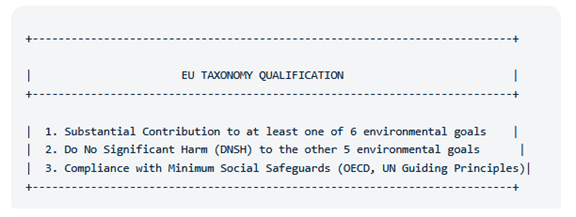
The Six Environmental Objectives
The EU Taxonomy targets six core ecological aims:
- Climate change mitigation
- Climate change adaptation
- The sustainable use and protection of water and marine resources
- The transition to a circular economy
- Pollution prevention and control
- The protection and restoration of biodiversity and ecosystems
Core Criteria for an Economic Activity to be “Taxonomy-Aligned”
For an economic activity to be classified as environmentally sustainable under the EU Taxonomy, it must fulfill three strict cumulative criteria:
- Substantial Contribution: The activity must make a positive, measurable contribution to at least one of the six environmental objectives listed above.
- Do No Significant Harm (DNSH): The activity must not significantly harm any of the other five environmental objectives. For instance, a green energy project that significantly harms local biodiversity or water tables fails the DNSH test.
- Minimum Social Safeguards: The company carrying out the activity must comply with baseline social standards, including the OECD Guidelines for Multinational Enterprises, the UN Guiding Principles on Business and Human Rights, and core International Labour Organization (ILO) conventions.
Technical Screening Criteria (TSC)
The European Commission operationalizes these requirements via delegated acts containing granular, data-driven Technical Screening Criteria. These criteria define exact quantitative and qualitative thresholds for what constitutes a “substantial contribution” or “significant harm” for dozens of specific sectors (e.g., manufacturing, transport, energy, construction).
Interaction with SFDR and CSRD
The EU Taxonomy does not exist in a vacuum; it serves as the foundational data engine for the broader European sustainable finance architecture:
- Sustainable Finance Disclosure Regulation (SFDR): Financial market participants must disclose the exact percentage of their fund portfolios that invest in Taxonomy-aligned activities (Articles 8 and 9 funds).
- Corporate Sustainability Reporting Directive (CSRD): Large European companies and listed entities must report the proportion of their turnover, capital expenditure (CapEx), and operational expenditure (OpEx) that aligns with the EU Taxonomy.
5. Integrating ESG into Your Investment Strategy
Transforming ESG theory into a practical, resilient investment blueprint requires a structured implementation framework. Investors should avoid a binary “all-or-nothing” approach and instead embed ESG across the entire portfolio lifecycle.
Step 1: Materiality Mapping at the Asset Class Level
Identify which ESG metrics matter for your target asset classes. For sovereign debt, governance and institutional strength dominate. For corporate equities, industry-specific material factors (via SASB or ISSB frameworks) dictate relevance.
Step 2: Employing Multi-Layered ESG Integration Strategies
- Negative/Exclusionary Screening: Systematically exclude sectors that violate core ethical or structural risk thresholds (e.g., controversial weapons, thermal coal extraction).
- Positive/Best-in-Class Screening: Select the highest-ranking ESG performers within each sector, encouraging laggards to improve to capture capital.
- Thematic Investing: Allocate dedicated capital to targeted sustainability themes, such as water infrastructure, energy transition, or circular supply chains.
Step 3: Active Ownership and Engagement
Passive ownership is insufficient. True ESG integration involves active proxy voting and direct engagement with corporate boards. Institutional investors leverage their voting power to demand carbon transition plans, executive pay reform, and supply chain transparency.
Conclusion
The materiality of ESG factors is a structural reality of the modern economic landscape. Environmental degradation, shifting social contracts, and governance standards directly impact asset values, cash flows, and survival timelines. By recognizing that ESG factors are core financial indicators rather than peripheral preferences, investors can build portfolios that withstand systemic shocks, capture emerging economic transitions, and align with rigorous international standards such as the EU Taxonomy. Incorporating these principles is no longer optional for sophisticated strategy formulation; it is the fundamental baseline of fiduciary responsibility and long-term value creation.
 Green Officer