
Abstract: The quantification of corporate greenhouse gas (GHG) emissions forms the empirical backbone of global climate mitigation strategies. Established by the World Resources Institute (WRI) and the World Business Council for Sustainable Development (WBCSD), the Greenhouse Gas Protocol Corporate Standard provides the preeminent accounting framework for categorizing emissions into three distinct operational scopes. This article delivers a comprehensive scientific and practical dissection of Scopes 1, 2, and 3, elucidating underlying thermodynamic and stoichiometric principles, mathematical formulations, categorical boundaries, and systemic reduction pathways. Detailed operational examples and quantitative annexes are provided to operationalize theoretical constructs into audit-ready carbon metrics.
1. Introduction: The Architecture of the GHG Protocol
Corporate carbon accounting transforms atmospheric physics and chemical stoichiometry into corporate governance metrics. The GHG Protocol Corporate Accounting and Reporting Standard mandates that organizations establish clear inventory boundaries before quantification.
Organizational boundaries can be defined using two distinct approaches:
- Equity Share: Accounting for GHG emissions according to the economic interest (equity share) in the operation.
- Control Approach: Accounting for 100% of emissions from operations over which the company has Financial Control or Operational Control.
Once boundaries are fixed, emissions are parsed into three scopes to prevent double counting and clarify responsibility across value chains.
2. Scope 1: Direct Greenhouse Gas Emissions
2.1 Scientific Definition and Source Typology
Scope 1 emissions encompass all direct physical emissions from operations owned or controlled by the reporting organization. Chemically, these involve the oxidation of hydrocarbon fuels or the direct release of fugitive gases into the troposphere.
Primary source categories include:
- Stationary Combustion: Fuel utilization in boilers, furnaces, turbines, heaters, and internal combustion engines.
- Mobile Combustion: Operation of company-owned or leased motor vehicles, trucks, forklifts, aircraft, and marine vessels.
- Process Emissions: Chemical or physical transformations occurring on-site (e.g., calcination of limestone during Portland cement production:

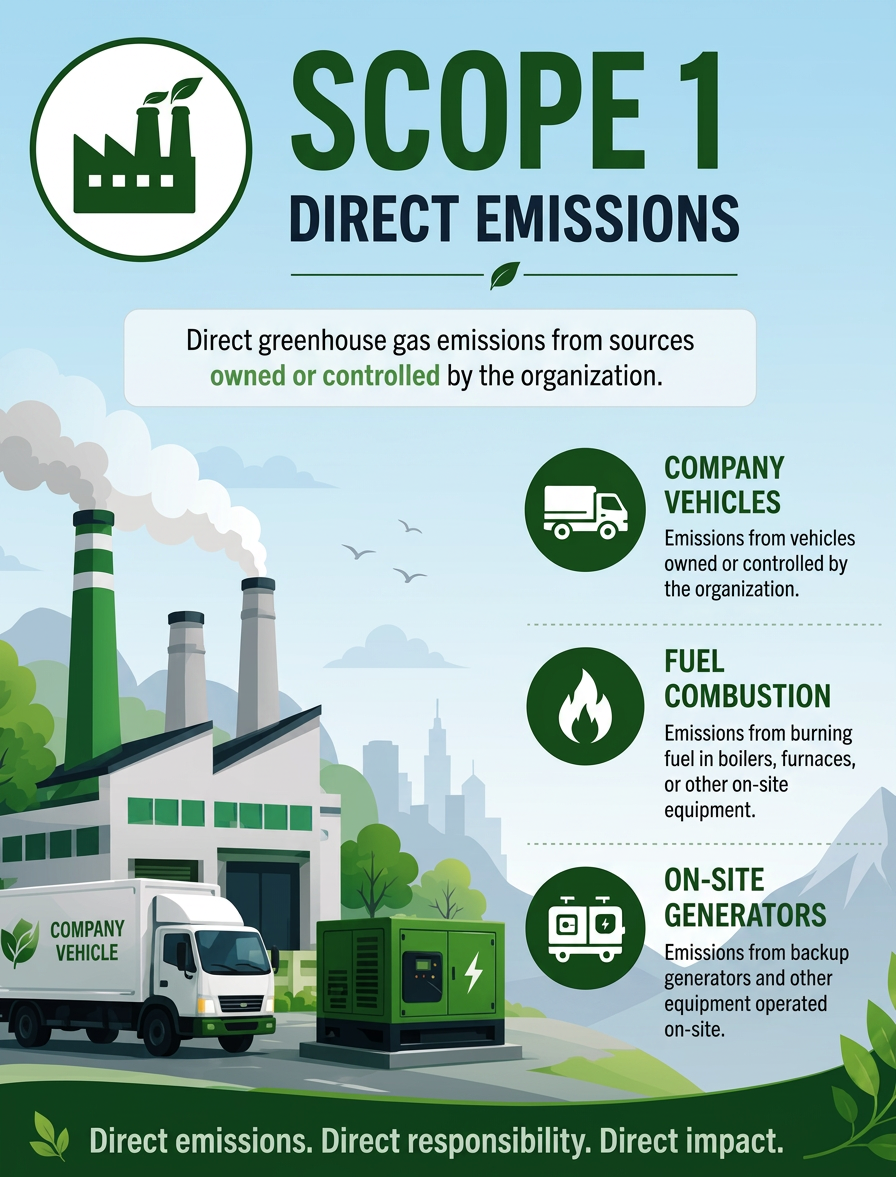
Fugitive Emissions: Unintentional or intentional releases of synthetic or natural gases, such as hydrofluorocarbons (HFCs) from commercial refrigeration leakage, methane CH4 leaks from natural gas transmission infrastructure, or sulfur hexafluoride SF6 from electrical switchgear.
2.2 Mathematical Formulation
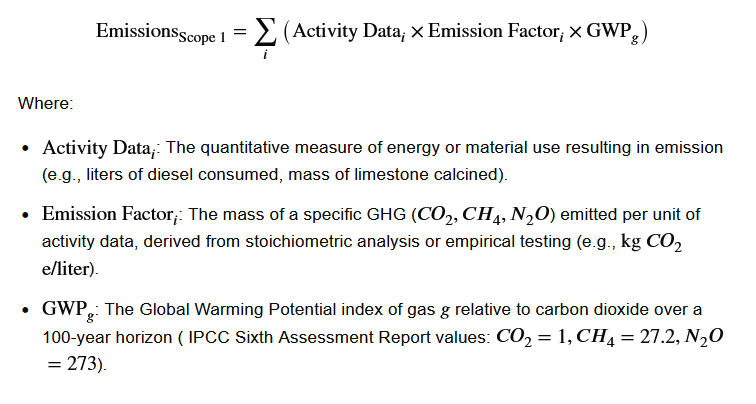
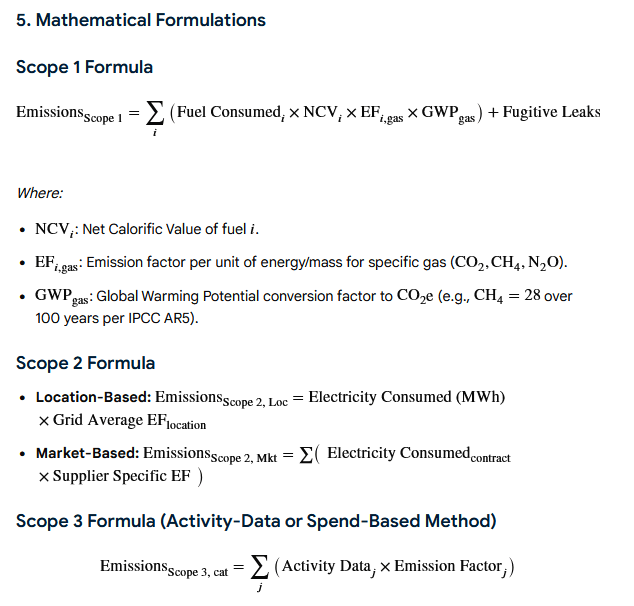
The general mathematical model for Scope 1 emissions calculation relies on activity data multiplied by a specific emission factor and adjusted for Global Warming Potential (GWP):
3. Scope 2: Indirect Emissions from Purchased Energy
3.1 Scientific Definition and Dual-Reporting Framework
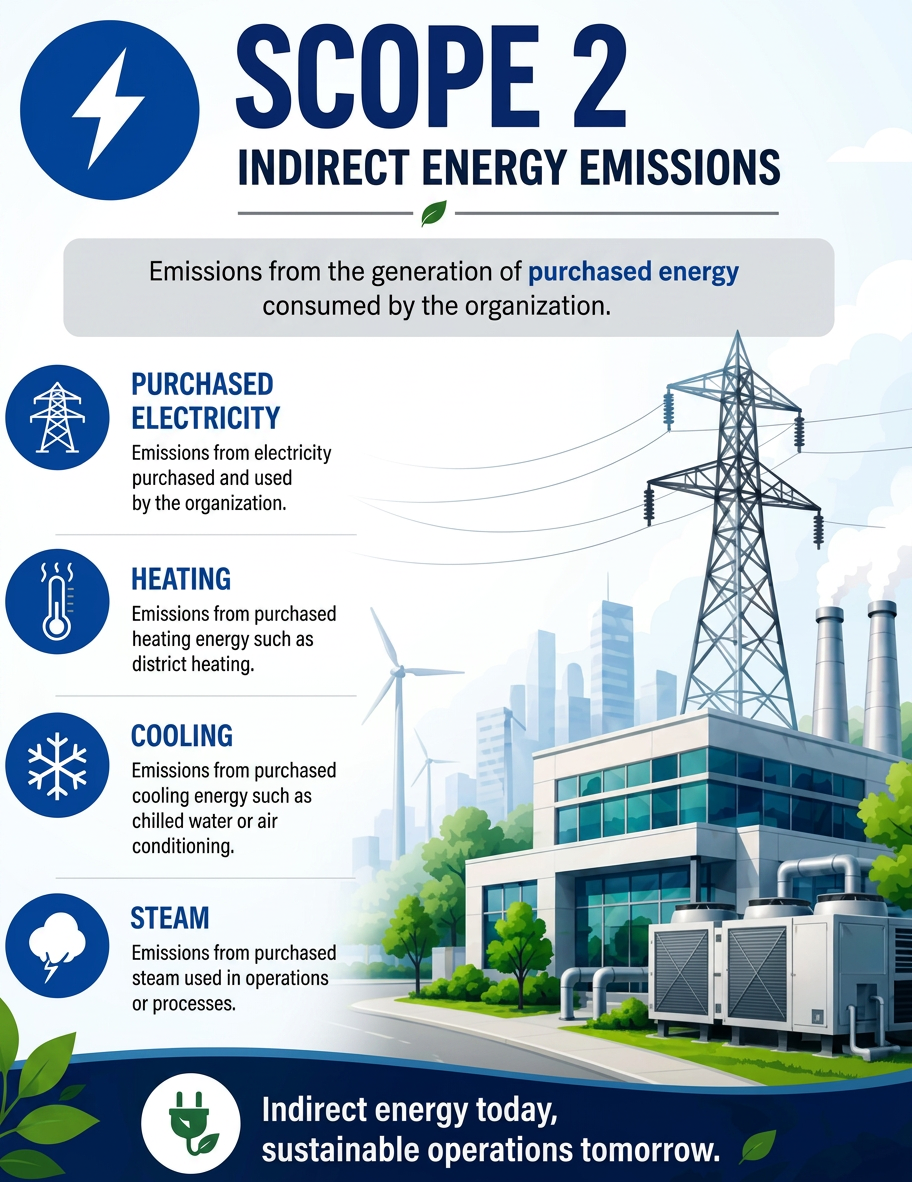
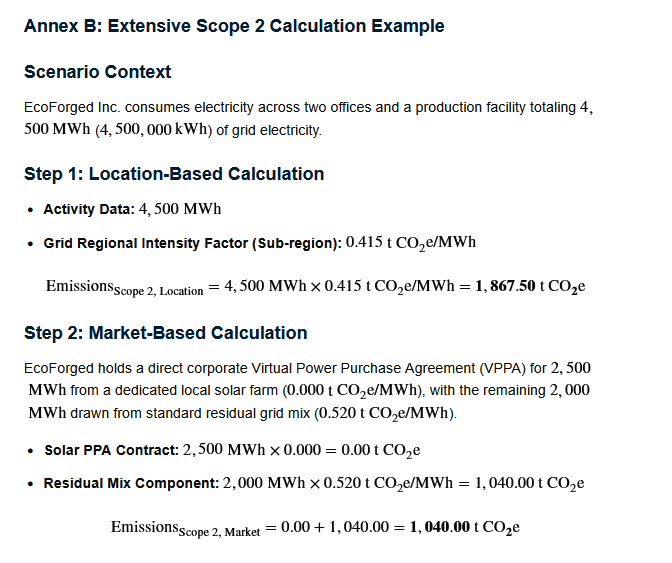
Scope 2 emissions are indirect emissions generated from the generation of electricity, heating, cooling, and steam purchased and consumed by the reporting entity. These emissions physically occur at the point of generation (e.g., a coal-fired power plant), but the electricity consumer creates the demand-pull driving the combustion.
The GHG Protocol Scope 2 Guidance requires a dual-reporting methodology:
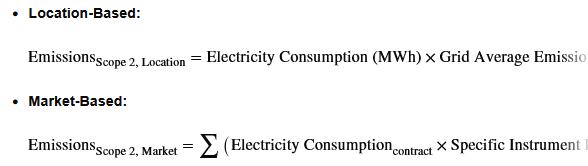
- Location-Based Method: Reflects the average emission intensity of grids on which energy consumption occurs, using regional or sub-national emission factors.
- Market-Based Method: Reflects emissions from electricity products that the organization has purposefully chosen (e.g., Power Purchase Agreements (PPAs), green tariffs, or unbundled Energy Attribute Certificates/Guarantees of Origin).
3.2 Mathematical Formulation
4. Scope 3: Value Chain Greenhouse Gas Emissions
4.1 Categorical Architecture
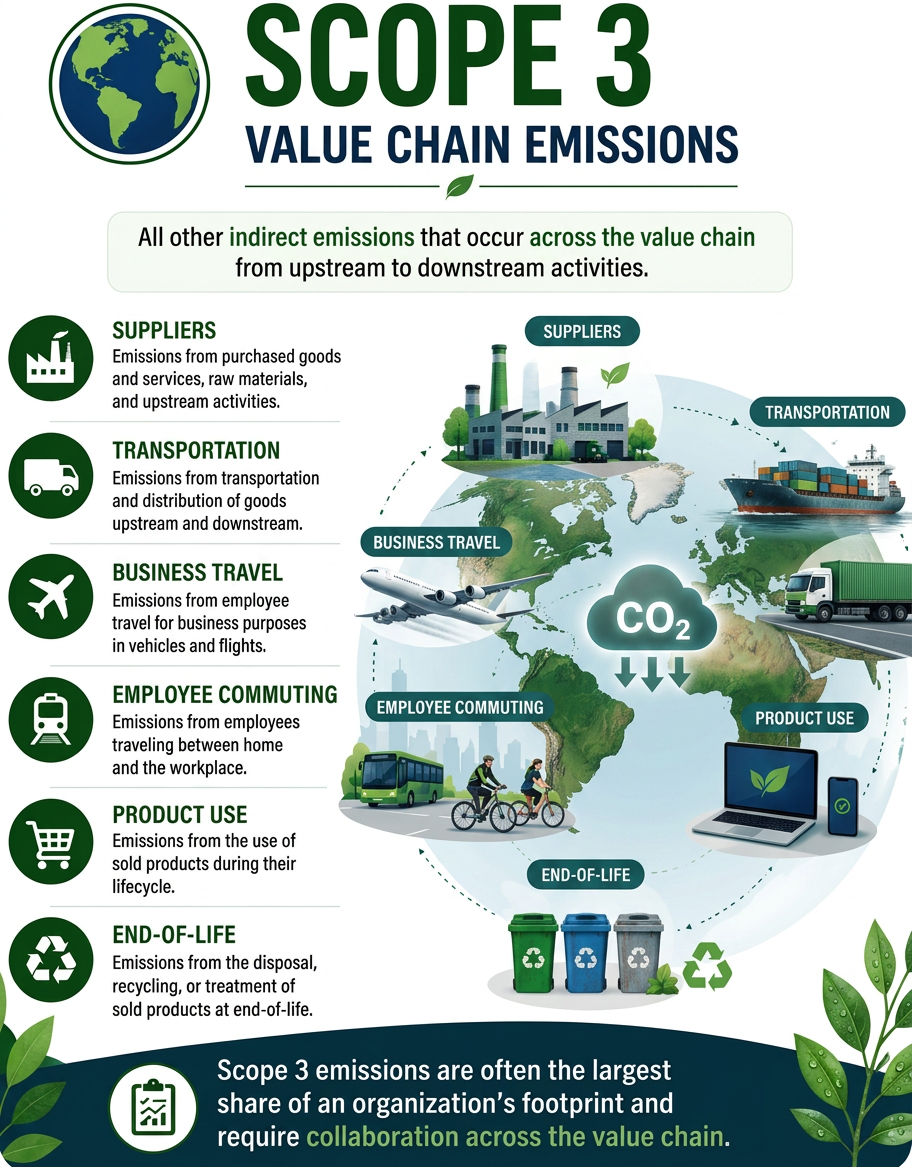
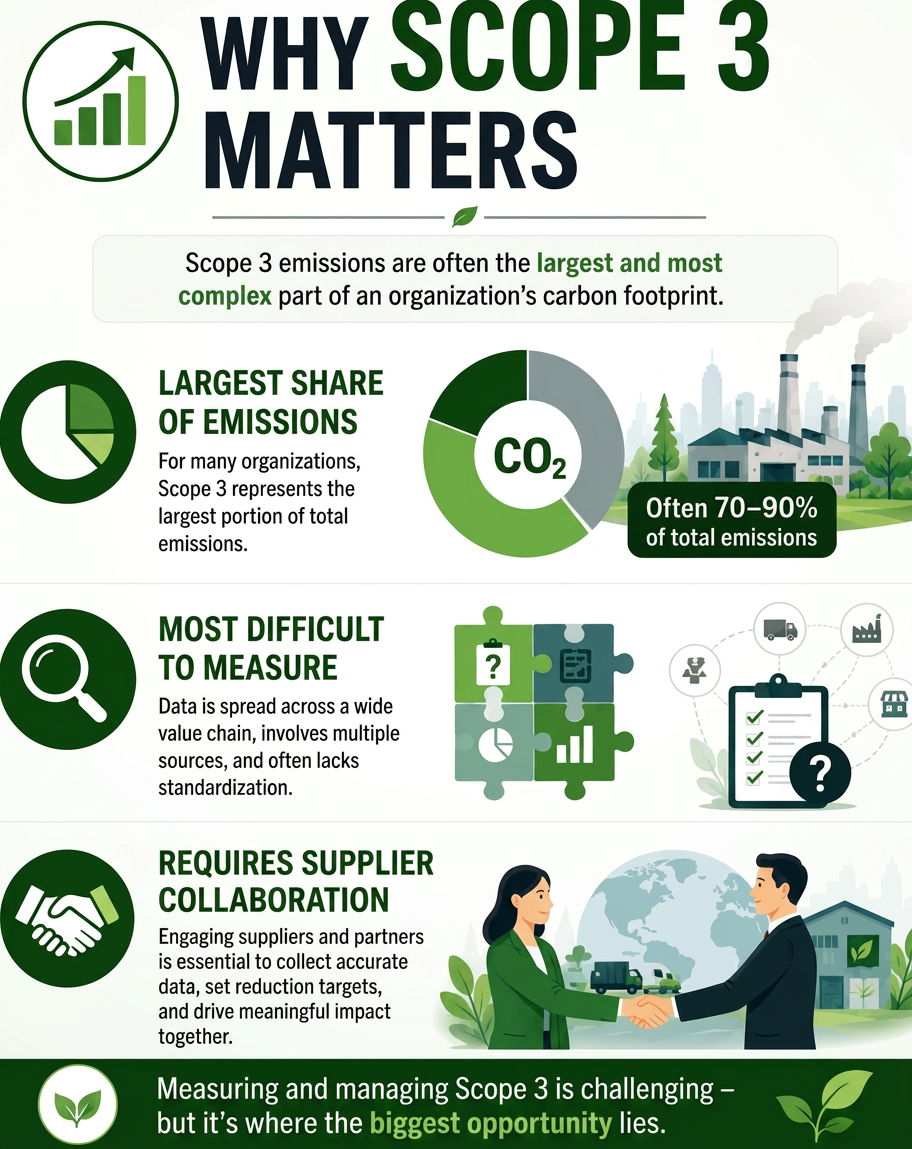
Scope 3 emissions are all other indirect emissions (not included in Scope 2) that occur in the value chain of the reporting company, including both upstream and downstream activities. Because these fall outside the direct control of the organization, Scope 3 accounting represents the frontier of methodological complexity.
The GHG Protocol categorizes Scope 3 into 15 distinct areas:
- Upstream Categories (C1–C8):
- Purchased Goods and Services
- Capital Goods
- Fuel- and Energy-Related Activities (not included in Scope 1 or 2)
- Upstream Transportation and Distribution
- Waste Generated in Operations
- Business Travel
- Employee Commuting
- Upstream Leased Assets
- Downstream Categories (C9–C15):
9. Downstream Transportation and Distribution
10. Processing of Sold Products
11. Use of Sold Products
12. End-of-Life Treatment of Sold Products
13. Downstream Leased Assets
14. Franchises
15. Investments
4.2 Mathematical Framework
Scope 3 quantification uses hybrid approaches blending primary data (supplier-specific data) and secondary data (spend-based or average-data methods):

Annex A: Extensive Scope 1 Calculation Example
Scenario Context
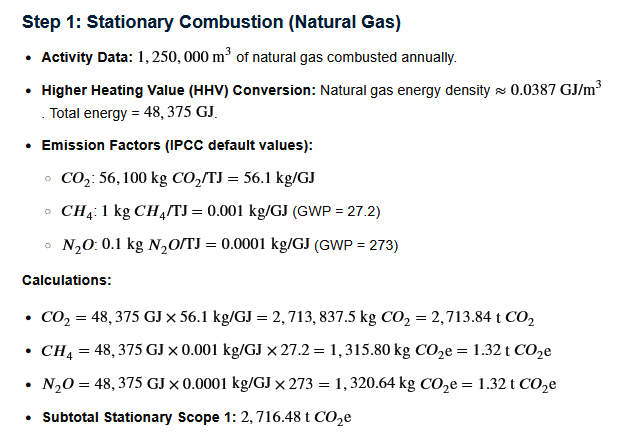
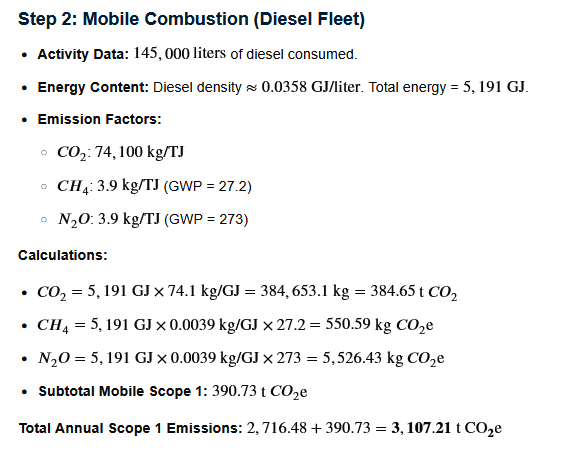
Consider an industrial manufacturing facility (EcoForged Inc.) operating in 2025. We calculate annual Scope 1 emissions from two discrete sources:
- Stationary Combustion: Natural gas consumed in a primary industrial boiler.
- Mobile Combustion: Diesel consumed by a fleet of on-site logistical forklifts and transport vans.
 Green Officer